


Daily mental health support in your app
You don’t need to know where to start. AI helps you understand what you need now and choose a small first step. It guides you through more than 300 self-help tools and each next step at your pace, using regular check-ins and your feedback.
Free, no card needed. iOS and Android.


From understanding your feelings to finding self-help tools that suit you


Mental health support without waiting for the first appointment
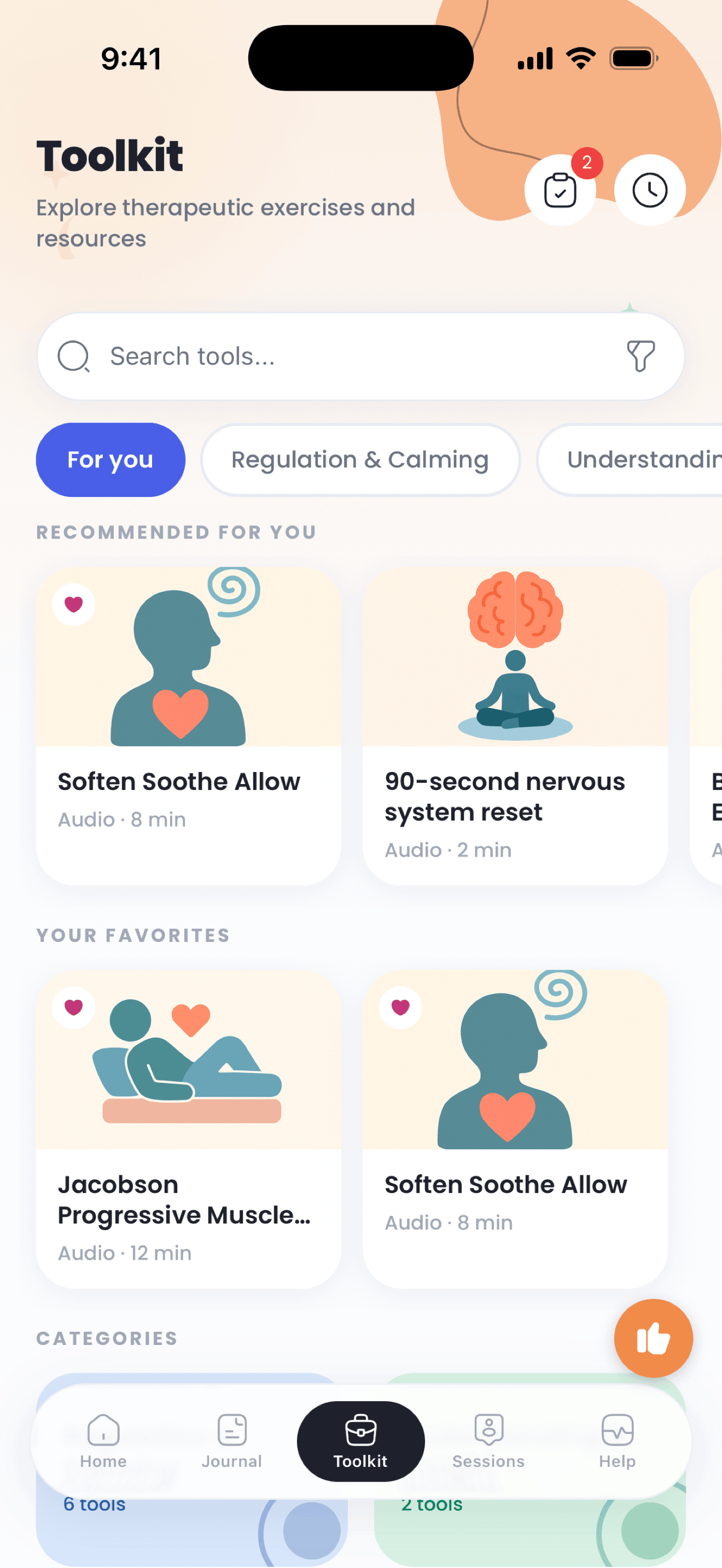

Self-help when you need it
Use the app’s exercises and routines between sessions. Explore self-help tools, track your mood and reflect with a mood journal.
Start free

300+ tools at hand, 24/7
Anxiety at 2 a.m.? A dip between sessions? Reach straight for proven exercises: breathing, a mood diary, mindfulness techniques.
Start free

You are not in this alone
Explore exercises for difficult moments and use your mood journal to reflect on what you are going through. Take each small step at your own pace.
Start free
Start with the app that is with you every day.
Daily support in a single app: 300+ self-therapy tools, an emotions journal and small routines you build at your own pace. All at your fingertips, whenever you need it.
Get the app


Start free, grow at your own pace
You can start with the free plan, which includes many self-help tools, or access the full catalogue, routines and habits with PREMIUM. You choose your plan and can change it whenever you want.



Start free, no payment card needed
Free plan FREE
Get started risk-free. The FREE plan gives you the questionnaire, the mood diary and a large part of the self-therapy tools: everything you need to really begin and use day to day. No payment card, no commitment.
Start free



The full toolset in the PREMIUM plan
PREMIUM planUnlock the full catalogue of 300+ self-help tools, routines and habits, and lift the app’s remaining limits. The PREMIUM plan is billed monthly or yearly and gives you unlimited access, at your own pace.
Choose PREMIUM
All in one place: self-help and daily reflection
HelpClinic guides you step by step: understand what you’re feeling, try self-help tools, build supportive routines, and use your mood journal for reflection. You can do it all from home and at your own pace.
Start freeHelpClinic benefits
-
300+ self-therapy tools
Breathing exercises, a mood diary, CBT techniques and meditations, ready when you are, all evidence-based.
-
Routines and habits
The app suggests small daily routines and reminds you of the next step. These reminders can help you practise routines consistently and notice which ones work for you.
-
Support between sessions
Between sessions with a professional outside the app, self-help tools and routines are right there.
-
EMERGENCY feature
Tap for emergency numbers and crisis contacts. HelpClinic does not call for you.

-
Mood journal
Space to reflect with your mood journal. Explore your feelings at your own pace.
-
Self-help at your own pace
When the moment feels right, try a self-help exercise or explore your feelings in your mood journal.
-
Knowledge Base from psychologists
Trustworthy articles on anxiety, stress and emotions, created with experts and our academic partner, the Medical University of Lodz.
-
A mobile app with access to everything
Your self-help tools, routines and journal are available 24/7. Explore your feelings in your mood journal. The FREE plan is free, and you can switch to PREMIUM whenever you want.


An illustrative example: When anxiety keeps you awake at 3 a.m., you can try a breathing exercise. It may help you settle and fall asleep again.


Emma
Using the app for 3 monthsI started with one small morning routine, literally five minutes. The app reminds me and suggests the next step, so for the first time in ages something actually stuck.

James
Started with small stepsThe emotions journal sounded trivial, until I saw the patterns. Now I know what winds me up and how to respond before my emotions take over.

Sofia
Keeps an emotions journalI go to therapy, but the hardest part is the days between sessions. Short grounding exercises help me find my footing when I feel things starting to spiral.

Daniel
Finds balance between sessions

Frequently asked questions


No. HelpClinic offers self-help tools for everyday wellbeing. Self-help features, routines, the journal and automated AI suggestions can support you day to day and between sessions. They are not a therapist, diagnosis or treatment, and they do not replace professional help. If you need professional care, seek a qualified provider outside HelpClinic.
For anyone who wants to look after their wellbeing, whether before starting regular therapy or between sessions. According to WHO, 1 in 6 people in the European Region lives with a mental health condition. You do not need a diagnosis or a “serious enough” reason to start looking after yourself. If you feel anxious or stressed, are sleeping poorly, or simply want to understand your emotions better, you are in the right place.
You can have the app for free. The FREE plan needs no card and gives you the questionnaire, the mood diary and a large part of the self-help tools. When you want more, the PREMIUM plan unlocks the full catalogue of 300+ tools, routines and habits and lifts the remaining limits. It is billed monthly or yearly. You always decide how much support you need and can change it whenever you want.
Yes. We follow privacy law and safeguard your data. Your diary and exercise entries are yours. We do not sell your data. Our Privacy Policy covers what we collect, provider processing, and legal or safety sharing. HelpClinic is developed with psychologists and our academic partner, the Medical University of Lodz.
The easiest way to start is with a short questionnaire: a few questions that take just a few minutes. Based on your answers, you will get a personalised summary and a possible first step suited to what you are going through. After that, self-help tools, routines and your mood journal are close at hand. You do not need to know where to start. Explore the app step by step.
If you or someone close to you is in immediate danger, call your local emergency number now: 911 in the US, or 999 or 112 in the UK and Europe. For crisis support any time, you can call or text 988 in the US (Suicide & Crisis Lifeline), or reach the Samaritans free, 24/7, on 116 123 (UK and Ireland). In the app, the EMERGENCY feature takes you to emergency numbers and trusted help in one tap. HelpClinic is not an emergency service, but it will always point you to immediate support.
Start with a community mental health center, a nonprofit clinic, or a therapist who offers a sliding scale. Ask for the exact self-pay fee, cancellation policy, and wait time before booking. If you may qualify for Medicaid, apply through your state program and ask which local clinicians accept it. Training clinics at universities can also offer lower-cost sessions. Availability varies, and some services have long waits, so contact several places.
The 3-3-3 rule is a grounding exercise: name three things you can see, identify three sounds, then move three parts of your body. Use it when your thoughts are racing and you need to reconnect with the room around you. Go slowly and describe each detail plainly. It may reduce the intensity of the moment, but it does not solve the cause of persistent overthinking or replace professional care.
To manage overthinking, write the thought down, separate what you can act on from what you cannot, and choose one small action with a time limit. Set aside a brief worry period later instead of debating the thought all day. Slow breathing, a walk, or a simple task can help shift attention. If this keeps disrupting sleep, work, or relationships, talk with a licensed clinician; self-help tools have limits.


Our partners
HelpClinic content developed with specialists and our academic partner, the Medical University of Lodz

Medical University of Lodz
Our academic partner supports us with expertise behind our evidence-based content and tools.
HelpClinic Knowledge Base

After an anger self-check: reflect on patterns and choose an action
Your anger self-check score can start a reflection. Look at recurring situations, what helped, the impact on your life, and your boundaries before choosing a step.
Read more: After an anger self-check: reflect on patterns and choose an actionAfter a PTSD self-check: understand your result and choose a next step
After a PTSD self-check, you may want time to reflect. Understand the score's limits, consider your answers in context, and choose a small next step and support.
Read more: After a PTSD self-check: understand your result and choose a next step
Panic Attack or Something Else? Heart Racing and Breathing
Heart racing and shortness of breath can come from panic or a physical problem. Learn the warning signs and what to tell a doctor.
Read more: Panic Attack or Something Else? Heart Racing and Breathing
How to Prepare for Your First Therapy Appointment
Your first appointment can start with one honest sentence. Learn what to note beforehand, what to confirm, and how to judge the fit afterward.
Read more: How to Prepare for Your First Therapy Appointment


You are not alone in this
Millions of people face the same thing. See how big the problem really is and discover that the first small step is within your reach.
For the United States: In crisis, call or text 988. Immediate danger: call 911.


HelpClinic is fully in the app: 300+ tools in your pocket.
Get the app